








The “Care for Your World” movement is a boundaryless initiative that encompasses the entire ecosystem required to build a better life, including production, use, ecology, and social life. It aims to inspire every individual to make a difference with a sense of care, starting with themselves, their habits, and their home, and extending to every place they touch within their sphere of influence: their workplace, street, neighborhood, city, country, and ultimately the planet. Under the Care for Your World movement, we organize our sustainability strategy around four main pillars. By focusing on creating value for all stakeholders in our ecosystem, we aim to leave a more livable planet for future generations.At Kaleseramik, we pursue our sustainability journey together with our parent company, Kale Group. We have adopted the “Care for Your World” movement, launched by Kale Group in 2021, as the foundation of our sustainability strategy. Through this strategy, we align with national and global objectives, particularly the United Nations Sustainable Development Goals. Our priority is to view the world from a more responsible perspective by creating shared economic, social, and environmental value across all our activities.

Sustainability
Kale Group Sustainability Strategy
As Kale Group, we view sustainability not only as an environmental responsibility but also as an integral part of our corporate culture and the way we do business. Our sustainability strategy, developed in line with this approach, aims to increase our social impact, reduce our environmental impact, and strengthen our reputation and credibility among our stakeholders by creating long-term value.
Our strategy has two primary focus areas: first, to enhance our environmental and social impact through sustainability-focused practices while contributing to long-term value creation; and second, to reinforce our position as a highly reputable institution that sets an example in our sector through its responsible and transparent approach in this field. Accordingly, we assess all our processes holistically in terms of economic, environmental, and social indicators. We also consider financial and non-financial indicators from an integrated perspective. Through both the Group Sustainability Committee and the sustainability committees of our companies, we strive to achieve success across the Group. We track the success of this process through a clear anchor indicator: as Kale Group, we are committed to achieving ESG rating scores above the sector average.We have defined our strategic goals across four impact areas: cultural transformation, energy and resource management, sustainable business model, and social impact. These four areas demonstrate that we approach sustainability not only as an operational matter, but also as a structural transformation. Through our cultural transformation goals, we aim to integrate sustainability across all business units and foster shared awareness and ownership among our employees. In this context, we place particular emphasis on strategic human resources topics (talent management, career management, etc.). We also prioritize a fair working environment and the protection of employee rights; employee engagement; equal opportunity, diversity, and inclusion; and the health and safety of our employees across all workplaces by strengthening our occupational health and safety culture. Under energy and resource management, our key objectives are to improve resource efficiency, reduce our carbon footprint and water consumption, contribute to the protection of biodiversity, and integrate circular economy principles into our operations. We are expanding our investments in renewable energy and sustainable production processes.In the sustainable business model area, we implement business practices that strengthen digitalization, R&D and innovation; reduce our environmental impacts through clean technology investments; continuously improve the customer experience; and create long-term value. We apply environmental, social, and governance criteria at every stage, from the supply chain to product development. In doing so, we improve Kaleseramik's ESG performance while also supporting all stakeholders across our value chain in advancing in this direction. In the area of social impact, we aim to increase our contribution to the communities in which we operate. We develop tangible and measurable projects in fields such as education and local development. Our approach to responsible corporate citizenship is intended to make our social impact lasting. As Kale Group, we recognize our responsibility in combating climate change and are taking decisive steps within the framework of our sustainability strategy. In line with the goals we have set across environmental, social, and governance (ESG) areas, we aim to play a leading role in the sectors in which we operate by reducing our carbon footprint, improving energy efficiency, and developing innovative solutions. Guided by transparency, continuous improvement, and stakeholder engagement, we will continue our efforts to minimize the impacts of climate change. For a more sustainable future, we shape all our business processes in line with this policy and firmly support the transition to a low-carbon, environmentally friendly production model by adopting a circular business model. We are committed to progressing together with all our stakeholders on our sustainability journey and to creating value without compromising the principles of transparency and accountability. As Kale Group, we will continue to embrace our responsibility to leave a livable world for future generations and the ecosystem.
Care for Your World Movement
Sustainability Governance Structure
Within Kale Group, appropriate governance mechanisms have been established to ensure that the sustainability strategy and targets defined under the “Care for Your World” movement are embraced by Group companies and stakeholders, and to manage the related activities effectively. Accordingly, a sustainability governance structure has been established - from Kale Group and the senior management of Group companies to field operations - with clearly defined roles and responsibilities. The Group Sustainability Committee is responsible for leading all sustainability-related activities across the Group companies. The Committee defines Kale Group's sustainability strategies, policies, and action plans aligned with the Sustainable Development Goals and closely monitors progress. It also follows global and local developments, assesses sustainability risks that may affect Group companies, and guides the relevant risk management processes. In this context, Kaleseramik's sustainability targets are also reviewed by the Committee, which contributes to the company's efforts to achieve them. In 2024, the Group Sustainability Committee convened three times.
As sustainability targets form part of the company's strategic plan, these targets and the investments and activities considered necessary to achieve them are reviewed and ultimately approved by the Board of Directors. At the Board meetings held monthly throughout the year, performance against the indicators and the activities carried out are reviewed and monitored. Based on the Board of Directors' assessments, planned actions may be accelerated or revised.
The governance mechanism established to ensure that all Group companies and stakeholders adopt a sustainability perspective and progress toward specific targets in this field comprises the Group Sustainability Committee; Sustainability Manager; Group Human Resources Director; Corporate Communications and Impact Investments Director; Thematic Working Groups; Kaleseramik Sustainability Committee; Kaleseramik Sustainability Leaders; Kaleseramik Sustainability Working Groups; Kale Seramik Foundation (KSV); İbrahim Bodur Social Entrepreneurship (İBSG); Kale Design and Art Center (KTSM); and the Kale Volunteers Platform.
Environmental Certificates
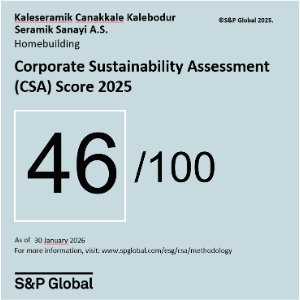
ESG Rating Performance
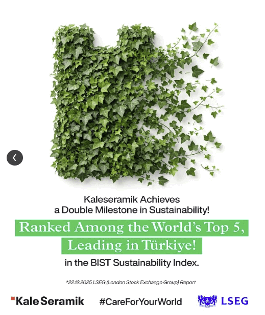
Kaleseramik remains on investors' radar and ranks among the world's leading companies in the ceramics sector in assessments by national and international ESG rating agencies.